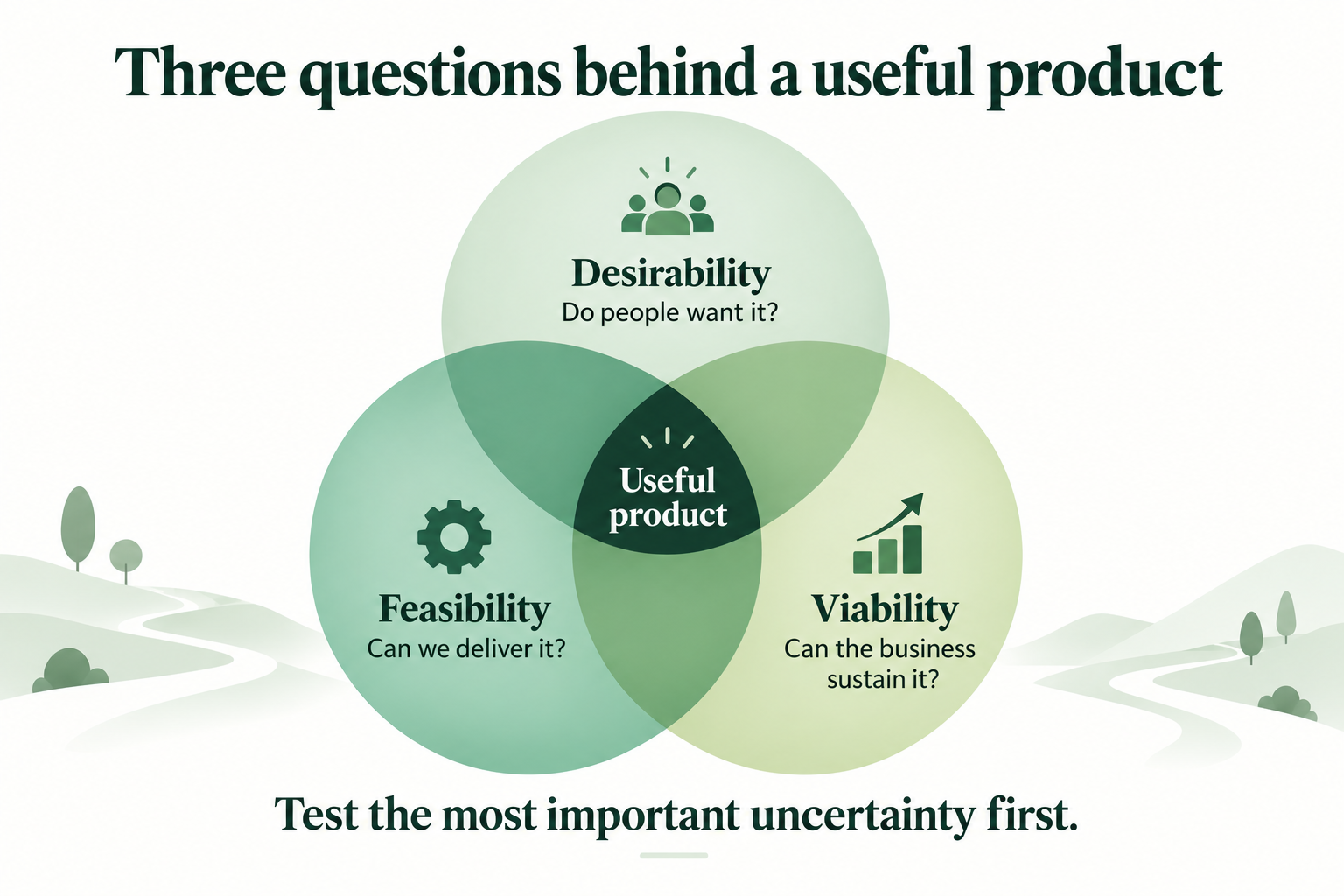
A promising idea needs more than an attractive feature list. My starting point is three questions: do people want it, can we deliver it, and can the business sustain it? Desirability, feasibility, and viability give a product team a shared way to examine those questions.
Desirability starts with the problem
Identify whose problem matters and how they handle it today. Look for evidence of frustration, repeated effort, or an unmet need. An enthusiastic reaction to a demo is useful feedback; a person choosing the product for a real task is stronger evidence.
Feasibility includes the whole delivery system
A working prototype is only a beginning. Consider the data, integrations, reliability, team capacity, and support needed to make the experience usable. For an AI feature, include the quality of its answers and the effort required to review them.
Viability asks whether the value can last
Explore who benefits, who pays, and what it costs to deliver and maintain the service. A product may attract attention while still creating more operating cost than value. Define the business assumption early enough to test it.
Turn the framework into a decision
Treat the three lenses as conditions to investigate, rather than scores to average. Strong demand cannot compensate for unreliable research or an unsustainable review cost. Choose the uncertainty most likely to invalidate the idea, then decide what evidence would let the team continue.
A hypothetical decision: the shortlist is useful, the review is costly
Suppose a sales team tests an AI lead-generation shortlist. The prospects look relevant, but checking invented or outdated company claims takes longer than researching them manually. Desirability looks promising; feasibility and viability remain unresolved. Faster drafting has not produced a faster, dependable result.
- Next assumption: restricting research to approved company websites and requiring a source for each important claim will reduce verification effort without weakening relevance.
- Next test: compare a small set of prospect briefs with manual research using the same criteria. Record unsupported claims and total time, including correction and checking.
- Continue only if the reviewed brief meets the agreed accuracy standard and saves enough effort to justify its operating cost.
- Stop or narrow the concept if unsupported claims persist or total preparation still takes longer than the manual approach after the bounded retest.
The decision is to test the research constraint before expanding pitch generation. Each lens has helped expose a reason to change the plan; none has cancelled out the others.