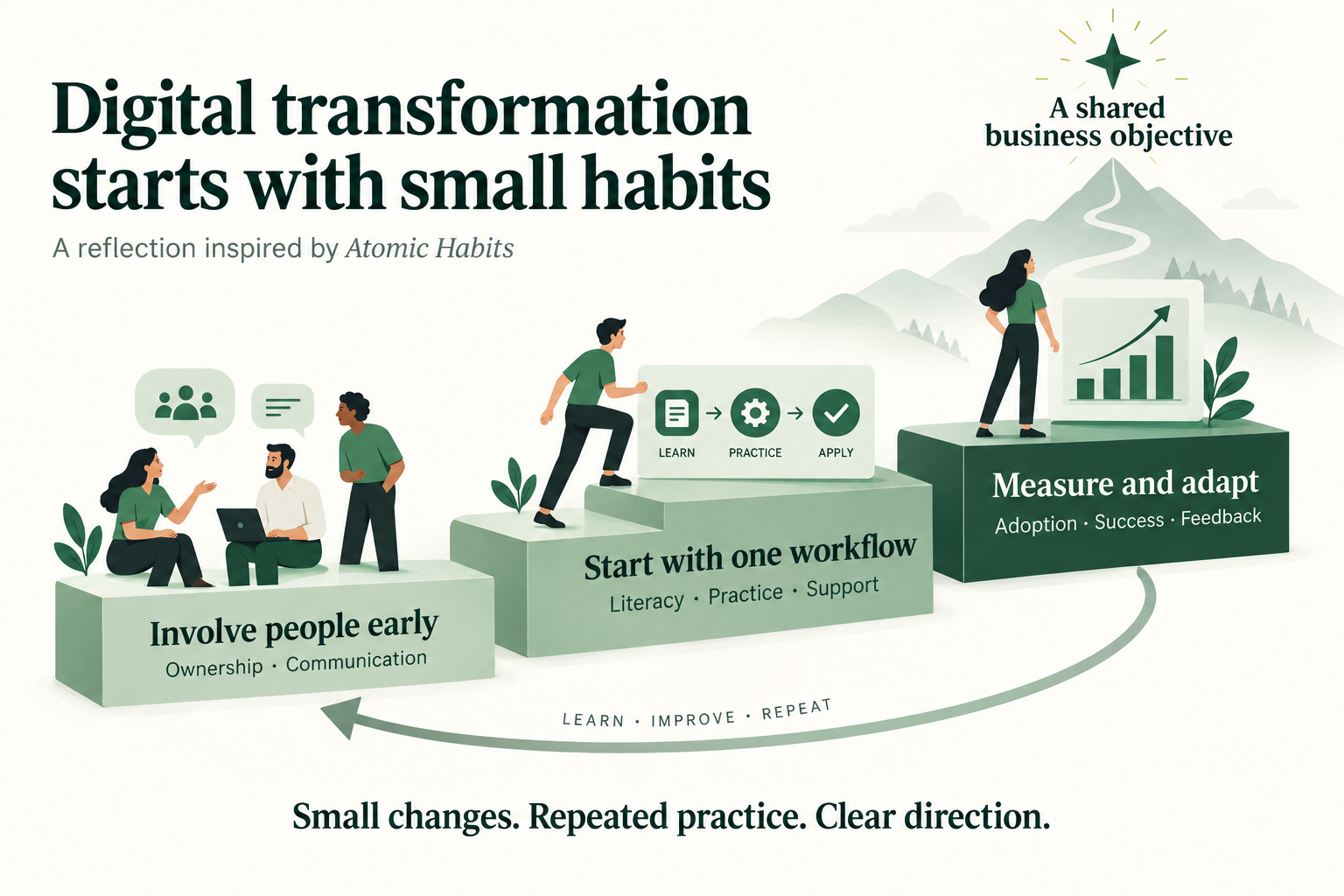
Digital transformation can sound like a major system launch or a complete redesign of the business. My starting point is more practical: how will people work differently tomorrow? A new tool creates little value if the daily routine stays the same.
James Clear’s Atomic Habits emphasises small, repeatable improvements and the systems that support them. I find that a useful lens for transformation. Applying it to organisational change is my own interpretation: make the desired behaviour easier, practise it in real work, and learn from what happens.
Involve people early and give ownership a clear meaning
Change management begins before implementation. Involve the people who do the work in identifying the problem and shaping the solution. They can explain exceptions, workarounds, and practical constraints that a process diagram may miss.
Make ownership clear: who sponsors the outcome, who makes decisions, who supports the workflow, and who gathers feedback? Communicate what is changing, why it matters, and where people can get help. Give staff a way to raise concerns and influence improvements.
Build literacy through useful practice
People start with different levels of confidence. A beginner may need a guided example and time to practise. A regular user may need help handling exceptions. An experienced user may be ready to coach others and improve the workflow.
Connect learning to a task people recognise. Teach the specific action they need to perform, let them try it, and provide support while the habit develops. Completing training is an early signal; successful use in everyday work is stronger evidence of adoption.
Start with one problem and one manageable change
Choose a recurring problem that is important enough to improve and small enough to learn from. Avoid expecting one large solution to resolve every issue at once. A limited pilot can expose problems before the approach expands.
Consider a hypothetical team replacing scattered request messages with one shared intake form. Begin with one request type and one team, with a named operations owner and a clear review routine. The purpose is fewer missed requests, not simply more form submissions.
Keep the objective clear and the approach flexible
State the business objective in plain language, such as reducing missed requests or shortening response time. Establish a baseline and a review point. Keep everyone working towards that outcome while allowing the implementation to change as evidence arrives.
- Adoption: what proportion of relevant work follows the new workflow?
- Success: can people complete the task correctly, with acceptable effort?
- Business value: is the original problem improving?
- Feedback: what causes confusion, delays, or a return to the old way?
When people return to messages, investigate the workflow
In this example, staff try the form, then return to messages. They still have to copy each request into another system, and urgent requests wait because nobody knows which route gets attention. Asking them to try harder would leave both problems in place.
The operations owner works with staff to remove duplicate capture, define an urgent path with a named responder, and publish a simple status and escalation routine. Give people a supported way to handle exceptions. Review missed requests, response time, and duplicate effort alongside form usage; adjust the workflow before expanding it.
Small habits can reveal what needs to change, but they do not replace structural work. A lasting solution may require an integration, revised incentives, or authority to change the process. Surface those dependencies and give them an owner rather than treating weak adoption as resistance.
For me, lasting transformation grows through changes people can understand, use, and sustain. Small steps need a clear direction. Repeated learning keeps those steps connected to the business outcome.